On February 6, 2018, at 2045 UTC, the first Falcon Heavy was launched into space. It contained a very special payload- a Tesla Roadster with Starman. Why was this the payload? This launch was considered extremely risky. According to Elon Musk , there was a 50- 50 chance of success on the first launch. No one wanted to risk a multi-million dollar payload with something that had such a high chance of failure.
That being said, there is a mechanism in place for deciding what to send with such a risky mission. That is, send a dummy payload. A dummy payload is simply one that doesn’t cost very much. There are a large variety of such payloads. Antares launched a Cygnus mockup . Falcon 9 launched a Dragon qualification unit . Other payloads have included concrete blocks, tanks of water, and highly experimental spacecraft. Dragon 2 wasn’t quite ready for a test flight, and thus SpaceX didn’t have any test equipment to bring on the voyage. So what were they to do?
The first clue about the payload came in a tweet from Elon Musk:
Payload will be my midnight cherry Tesla Roadster playing Space Oddity. Destination is Mars orbit. Will be in deep space for a billion years or so if it doesn’t blow up on ascent.
— Elon Musk (@elonmusk) December 2, 2017
I didn’t really believe it, especially as he seemed to back out of it a few times. Elon is known to pull pranks via Twitter. But then came these photos, and I knew it was true.
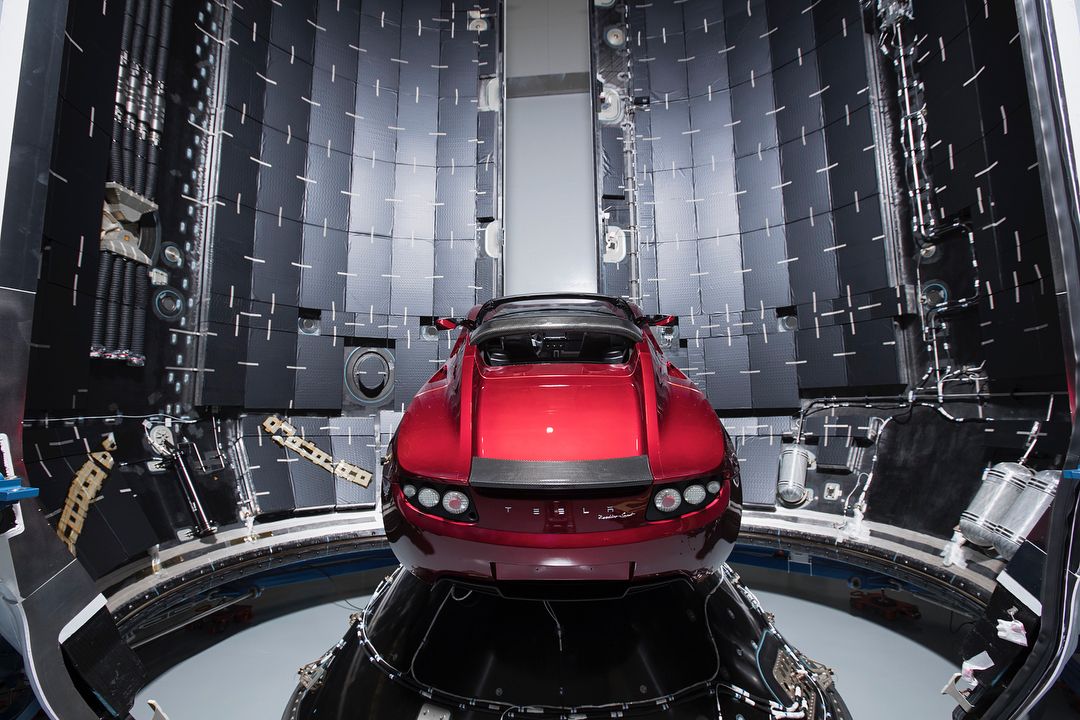
The day of the launch approached, and one last surprise was in play. The car would have a driver, named Starman. This one caught me off guard, although it is so perfect.
The day of the launch, I was surrounded by a bunch of engineers. During the launch, I had a mental timeline of what was happening, and was narrating. I watched the smoke come out for a whole slow 5 seconds before it lifted off. And I thought, wow, it’s off the ground! As there were 2.3 million viewers, the second most in YouTube history at that time, the stream was a bit slow. But I continued to count off the milestones as they passed. The first one happened at about T+25 seconds, where I had calculated it would be far enough from the Launch Pad to not blow it up. I then continued to mark the milestones, each successful, until the two booster landed simultaneously. The final one, of the center core landing, of course was left as a mystery initially, but later Elon Musk confirmed that the center core ran out of TEA-TEB, which caused it to slam into the Atlantic Ocean at around 300 mph (500 km/h) near the drone ship Of Course I Still Love You.
I then proceeded to await news for the other 2 burns that were planned, which were not aired. Falcon Heavy did do a few test items, the most notable being a burn after coasting for 6 hours. The 6 hour timeline is significant because it allows for a direct to Geostationary orbit to be performed, which the military desires. This allows SpaceX to compete for all US military contracts.
I will leave you with this amazing video that wraps up the whole launch campaign beautifully. I have watched it more than once, and not regretted doing so at all.